

Am I autistic? Might I be gifted? Do I have ADHD? Why am I like this?
FREE 16-page self-exploration guide exploring giftedness and neurodivergence
Perhaps giftedness has always been part of you—but no one showed you what it truly means. Perhaps you are twice-exceptional—carrying complexity, sensitivity and struggle in the same breath. And perhaps this is the missing piece that finally explains everything.
Your child or someone you know gets diagnosed with ADHD or autism. They're very bright, creative but not doing as well as everyone thinks they should be in school or in the workplace. Not doing as well as they think they should be.
Suddenly you're seeing yourself and your own school days differently.
The struggles you thought were your fault. The way you've always felt "too much" and "not enough" at the same time—too much depth, too much intensity, too many questions. Not focused enough, not organised enough, not keeping up with things that "should" be simple. The exhaustion of appearing to cope whilst drowning inside.
You start wondering: Maybe I'm neurodivergent too?

This 16-page self-discovery guide will help you:
✓ Understand the twice-exceptional profile and why it's so often missed
✓ Recognise patterns from your own life (the hyperfocus alongside the inability to focus, the "bright but lazy" labels, the career confusion)
✓ See how giftedness and neurodivergence mask each other—and why that can make both invisible
✓ Make sense of why school was traumatic (and why it wasn't your fault)
✓ Understand multipotentiality and why it might be hard for you to "just choose one thing"
✓ Stop feeling broken because you're capable of complex thinking or but struggle with daily tasks

Here's what makes it complicated.
Giftedness is not just about having a high IQ. Giftedness is complex.
Being neurodivergent is not easily recognisable as each person’s profile of traits and ways of experiencing the world is unique.
Twice-exceptionality means being both gifted and neurodivergent at the same time.
And here’s the thing:
Your giftedness masks your neurodivergence. It compensates for struggles others would have noticed. You develop elaborate coping strategies that exhaust you but keep you "successful enough" for no one to see you are drowning.
Meanwhile, your neurodivergence masks your giftedness. Your disorganisation, sensory overwhelm, or social difficulties—your specific learning difficulties such as dyslexia or dyspraxia—meant no one took your intellectual needs seriously.
And this is why you may have spent years believing you were just:
Not trying hard enough (whilst exhausting yourself trying)
Too sensitive (whilst others dismissed your genuine pain)
Impossibly disorganised (whilst systems punished the way your brain naturally works)
Good at learning but terrible at some other aspects of life (and you couldn't understand why)
This pattern gets missed. Especially in women.
You might be bright. Academically able. Creatively talented. Athletic. Maybe you loved learning, especially when you could do so on your own terms.
And that's exactly what hid everything else, because you were so good at compensating for it all.
Maybe, you've always been deeply tuned into other people's feelings and motivations—absorbing their emotions, picking up on subtle shifts in mood—which could leave you overwhelmed and also confused about why no one else seemed affected the same way.
So you might have needed to keep a low profile, do what was expected of you and not rock the boat. And no-one saw your true capabilities.
When you're intelligent enough to compensate, no one sees the struggle—when you're struggling enough, no one sees the brilliance.
I have created this guide to help you explore whether this is you.
The boundaries overlap more than you think.
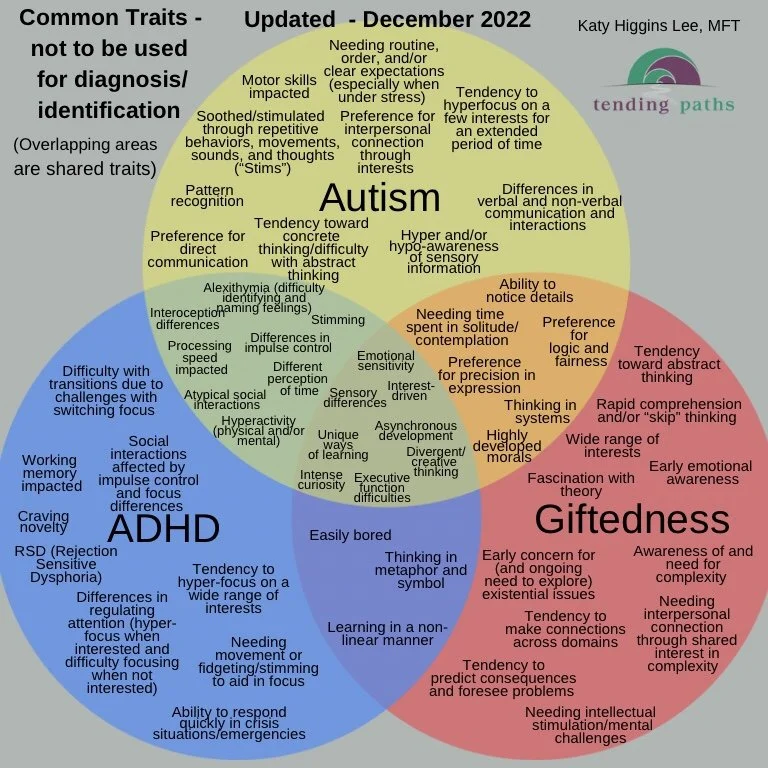
The traits of autism, ADHD, and giftedness overlap significantly—sharing sensitivities, intensities, abilities, and struggles that don't fit neatly into single categories.
Venn Diagram: Katy Higgins Lee, MA, MFT. Available as a free download at katyhigginslee.com/giftedness-autism-adhd-venn-diagram-pdf-free-download

What's inside:
Recognition checklists across key areas of experience
ADHD, autism, giftedness? Side-by-side comparisons to help you see which traits resonate
Your spiky profile: Rate yourself across different domains to see the gaps between your abilities
Reflection prompts: Gentle questions about what you recognise, what brings relief, what brings grief
Multipotentiality exploration: Understanding why you can't "just choose one thing
Gentle reflection questions designed to help you see yourself more clearly, without judgement.
These aren't diagnostic tools—they're prompts for self-discovery
Why I created this
I'm Davina, a trauma-informed psychotherapist specialising in educational trauma and parent support.
I created this guide because I wish someone had given it to me decades ago. Before all those years of "Why can't I just...?" Before all that unnecessary shame.
I discovered my own twice-exceptionality whilst writing my son Sam's story—recognising patterns I'd carried since childhood, misunderstood and blamed myself for.

This isn't a diagnosis. But it might support you to understand yourself better
Brilliant
✳︎
Scattered
✳︎
Intense
✳︎
Disorganised
✳︎
Empathetic
✳︎
Exhausted
✳︎
Brilliant ✳︎ Scattered ✳︎ Intense ✳︎ Disorganised ✳︎ Empathetic ✳︎ Exhausted ✳︎
Get your free 16-page self-discovery guide now
Enter your email below and I'll send it straight to you.
You will also receive my emails. You can unsubscribe any time.